Concepts of Programming Languages
Scheme
Instructor: Stefan Mitsch
Lisp and Scheme
- Lisp (LISt Processor)
- Influential programming language from the 1950s
- Originally motivated by logic / AI applications
-
Pioneered many PL concepts:
- automatic garbage collection
- first-class, higher-order, nested functions
- read-eval-print loop including runtime compilation with "eval"
- sophisticated macro system
- multiple dispatch / multi-methods
Lisp and Scheme
- Dialects: Common Lisp, Scheme, Clojure, Racket
- We will use Scheme
-
Sample Scheme function to find the length of a list
; This (recursive) function calculates the length of a linked list. (define (length l) (if (equal? l ()) 0 (+ 1 (length (cdr l))))) - Lots of Infuriating & Silly Parentheses
Scheme Resources
- See Worksheet 1 for how to install the SISC Scheme interpreter
- Books
- Revised Reports on the Algorithmic Language Scheme
- Revised Report on the Algorithmic Language Scheme, 1978
- R5RS-Revised5, 1998
- R6RS-Revised6, 2007
- R7RS-Revised7, 2013
Running Scheme
Literals in Scheme
-
Number literal
5 -
String literal
"hello world" -
Symbol
'helloworld
Arithmetic in Scheme
-
Arithmetic expressions use prefix notation
; (1 + 2) * 3 would be written in Scheme as follows (* (+ 1 2) 3) -
Parentheses are required for each operator
- Operator precedence not necessary!
-
Try out
(+ 10 5 2)
(- 10 5 2)
Operator Terminology
-
Prefix notation: operator before arguments
+ 1 2 -
Infix notation: operator between arguments
1 + 2 -
Postfix notation: operator after arguments
1 2 +
Functions
-
Define a function
squarewith parametern(define (square n) (* n n)) -
Invoke the
squarefunction(square 5) -
Invoke the
squarefunction twice(square (square 5))
Defining Functions
-
General form is
(define (f param_1 param_2 ... param_m) e_1 e_2 ... e_n) -
Takes
marguments - Body of function is a sequence of expressions
-
e_1,e_2, ...,e_n-1evaluated for side effect -
e_nis evaluated and its result is returned -
No
returnkeyword, no statements, just expressions -
beginlike C comma operator, but not needed(define (f param_1 param_2 ... param_m) (begin e_1 e_2 ... e_n))
Invoking Functions
-
Invoke function
fwithmarguments(f e_1 e_2 ... e_m-1) -
Parentheses are required
(square 5) -
Try in Scheme REPL
square 5
Evaluation Order
-
Expression
(f M N)is evaluated by-
Evaluating expression
Mto valueU -
Evaluating expression
Nto valueV -
Invoking function
fwith valuesUandV
-
Evaluating expression
-
defineis a special form, not a function, so it does not obey this convention
Booleans and Conditionals
-
=operator tests number equality(define (zero n) (= n 0)) -
Boolean values are
#tand#f -
ifis a non-strict special form(define (safe-divide m n) (if (= n 0) "divide by zero" (/ m n)))
Recursive Functions
- Recursive functions are common in Scheme
-
Factorial using conditional expressions
(define (fact n) (if (<= n 1) 1 (* n (fact (- n 1))))) -
Recall C factorial using conditional expressions
int fact (int n) {
  return (n <= 1) ? 1 : n * fact (n - 1);
}
Cons Cells
- A cons cell is a pair of two pieces of data
-
Pair of numbers
(cons 1 2) -
Pair of strings
(cons "hello" "world") -
Pair of a number and a string
(cons 1 "world") -
carandcdrfunctions extract components(car (cons 1 "world")) (cdr (cons 1 "world"))
Cons Cells For Linked Lists

- Cons cells (pairs) are used to represent linked lists
-
carposition for elements -
cdrposition for next cons cell
Cons Cells For Linked Lists
-
Linked lists built up using
()andcons -
Empty list
() -
Singleton list containing 41 only
(cons 41 ()) -
List containing 11, 21, 31, 41
(cons 11 (cons 21 (cons 31 (cons 41 ()))))
A More Complex Example
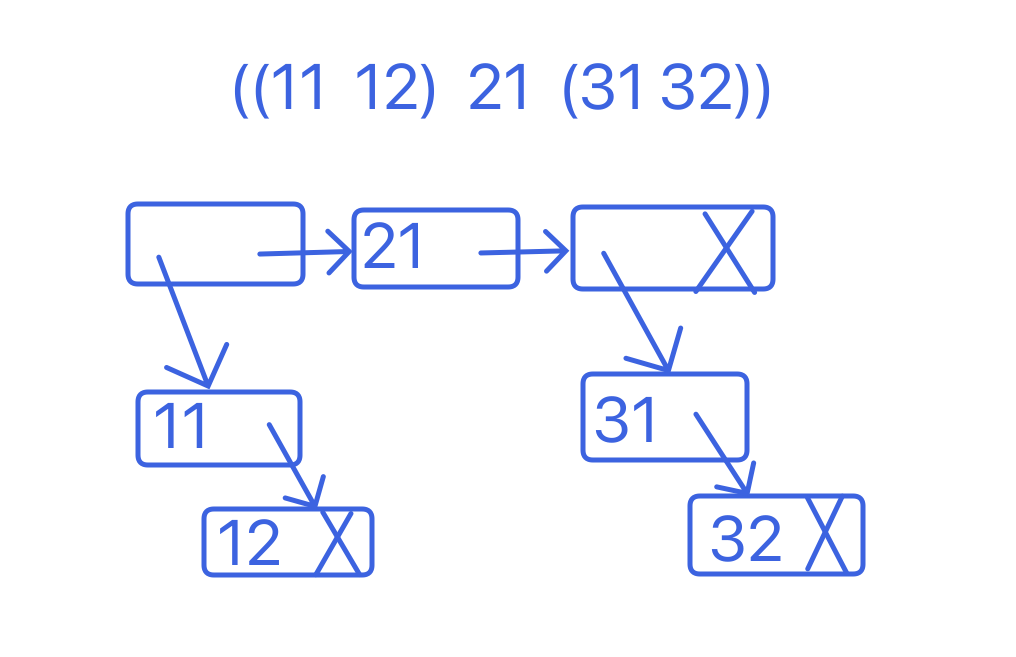
- Lists can be heterogeneous
Syntactic Sugar For Lists
-
quotespecial form prevents evaluation(quote (3)) (quote (1 2 3)) -
'is shorthand forquote'(3) '(1 2 3) -
listfunction evaluates args, puts results in a list(list 3) (list 1 2 3) (list 1 2 (+ 1 2))
Equality Testing For Lists
-
eq?for pointer equality(eq? (cons 1 (cons 2 (cons 3 ()))) '(1 2 3)) -
equal?for structural equality(equal? (cons 1 (cons 2 (cons 3 ()))) '(1 2 3)) - Pointer equality compares two pointers
- Structural equality traverses two structures
Recursive Functions On Lists
-
Compute length of linked list recursively
(define (length l) (if (equal? l ()) 0 (+ 1 (length (cdr l))))) (length '(5 6 7 8 9)) -
Or in Java
class Node {
  int item;
  Node next;
}

static int length (Node data) {
  return (data == null) ? 0 : 1 + length (data.next)
}
Recursive Functions On Lists
-
Compute length of linked list recursively
(length '(5 6 7))
--> (if (equal? '(5 6 7) '()) 0 (+ 1 (length (cdr '(5 6 7)))))
--> (+ 1 (length (cdr '(5 6 7))))
--> (+ 1 (length '(6 7)))
--> (+ 1 (+ 1 (length '(7))))
--> (+ 1 (+ 1 (+ 1 (length '()))))
--> (+ 1 (+ 1 (+ 1 0)))
--> (+ 1 (+ 1 1))
--> (+ 1 2)
--> 3
Dynamic Types
(symbol? 'x)
(number? 1)
(boolean? #t)
(string? "x")
(procedure? (lambda (x) (+ x 1)))
(pair? '(1 . 2))
(pair? '(1))
; (pair? '())
; (list? '(1 . 2))
(list? '(1))
(list? '())
- List only has one structure type: the pair.
- A non-empty list is just a special type of pair, with a terminal
S-Expressions
- Pairs are a kind of Symbolic-Expression (S-Exp)
-
S-Exps also include non-structured values, including numbers,
booleans, strings, symbols and
'(). -
Parsing a scheme program results in an S-Exp, which is then
sent to
evalfor evaluation. -
(quote exp)causesexpto be parsed without evaluation, resulting in an S-Exp.
Read-Eval-Print Loop (REPL)
-
Quoting delays evaluation
(+ 1 2) '(+ 1 2) (cons '+ '(1 2)) (car '(+ 1 2)) -
evalfunction evaluates an expression(eval (cons '+ '(1 2))) (define (add-all l) (eval (append '(+) l))) (add-all '(1 2 3)) -
readfunction reads an expression(read) (eval (read)) (eval (append '(+) (read)))