To Notes

IT 223 -- Jan 14, 2026

Review Problems

  1. Modify the R statements that we used to create the vector w of weight measurements for NIST-10 dataset, to show what the R dataframe for Weight looks like. Answer: execute these statements one at a time
    # Set the working directory to "C:/workspace".
    setwd("C:/workspace")
    
    # Check the resulting working directory.
    # It should be "C:/workspace".
    getwd( )
    
    # Display all files in the working directory
    dir( )
    
    # Create an R dataframe from the CSV file
    # nist-10.txt. CSV means comma separated value.
    weightDf <- read.csv("nist-10.txt")
    
    # Print the resulting data frame.
    print(weightDf)
    
    # Extract the Weight column from the dataframe:
    w <- weightDf$Weight
    
    # Print the extracted weight vector w.
    print(w)
    
  2. Use these R statements to create a graph of a normal curve:
    x <- seq(-4, 4, 0.05)
    y <- dnorm(x)
    plot(x, y, type="l")
    
    Answer: Here is the resulting R graph of the normal density:
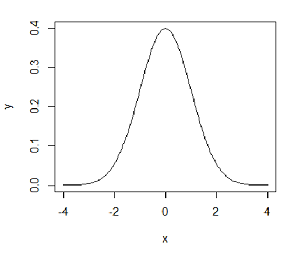
    Standard Normal Density
  3. Show that when the histogram bins are all the same width, the height of the bars is the count or frequency in each bin. However, when the widths of the bins are not equal, the vertical axis represents a density, with the vertical axis being Percent per Horizontal Unit. In the second case, the area of the bar represents the percentage of observations in that bin.
    Answer: Create one histogram with equal bin widths: [0, 1], (1, 2], and another histogram with unequal bin widths: [0, 1], (1, 4].
    x <- c(0.5, 0.5, 0.5, 1.5, 1.5)
    b1 <- c(0, 1, 2)
    b2 <- c(0, 1, 4)
    hist(x, breaks=b1, main="Equal Width Bins")
    hist(x, breaks=b2, main="Unequal Width Bins")
    
    The resulting histograms:

    Equal vs. Unequal Bins
    For the Equal Width Bins histogram, the vertical axis label is Frequency and the vertical units are the counts in each bin; for the Unequal Bin Widths histogram, the vertical label is Density and the vertical units are fraction of observations per horizontal unit.
  4. What is a critical point for a curve?
    Ans: a critical point of a curve is where the slope of the curve is horizontal For a normal curve, the x-value of the critical point is the maximum value of the curve. The normal curve is symmetric around the center.
  5. What is an inflection point for a curve?
    Answer: an inflection point of a curve is where the curve changes from concave down to concave up, or vice versa.
  6. What is the sample mean?
    Answer: the sample mean is another name for the sample average. If x1, x2, ... , xn is the dataset, the sample mean is the sum of the observations divided by the number of the observations:
           X = (x1 + x2 + ... + xn) / n

Descriptive Statistics

Practice Problems

  1. What happens to x and Q2 for a dataset
    1. if every observation is increased by 7?
      Ans: Both x and Q2 are increased by 7.
      xnew = (x1 + 7 + ... + xn + 7) / n
             = (x1 + ... + xn) / n + (7 + ... + 7) / n
             = x + n 7 / n = x + 7
    2. if every observation is multiplied by 3?
      Answer: Both x and Q2 are multiplied by 3.
      xnew = (3x1 + ... + 3xn) / n
             =  3(x1 + ... + xn) / n = 3 x
    3. if the largest observation is increased by 1000?
      Ans: The mean is increased by 1000 / n, the median is unchanged if n ≥ 3.
      (1/n)(x1 + ... + (xn + 1000)) = x + 1000 / n
  2. What happens to SD for a dataset if
    1. if every observation is increased by 7?
      Ans: the SD is unchanged because the spread is unchanged.
    2. if every observation is multiplied by 3?
      Ans: the SD is multiplied by 3 because the spread is multiplied by 3.
  3. Compute the 20%-trimmed mean of this dataset:
           1   7   4   6   94   5   5   7   3   6
    Answer: Trimming 10% of the variables off of the bottom and 10% off of the top, means omitting 1 and 94. The average of the remaining variables is 5.375.
    Perform this calculation using R. Answer: if x is the complete dataset, use
    mean(x, trim=0.05)
    
    where trim=0.05 means trim 0.05 of the observations from the left and 0.05 of the observations from the right.
  4. Without doing any calculations, compute the SD of this dataset:
         4   4   4   4   4
  5. Without doing any calculations, compute the SD of this dataset:
          0   0   0   0   10   10   10   10
  6. Use R to compute SD+ of the hypothetical exam scores.
  7. Compute the MAD of this dataset:
         20    10    15    15

Computing the Mean of a Histogram

  1. Practice Problem: Compute the sample means of the histograms in More Review Exercises, Exercise 1a, 1b, and 1c of the Jan 7 Notes. Use a weighted average of the midpoints of each rectangle weighted by the proportion of observations represented by that rectangle.
    Answer: Compute the weighted average (x1 w1 + ... + xn wn) / (w1 + ... + wn) , where x1 is the midpoint of the ith bin and w1 is the number or proportion of observations in the ith bin.
    Answer for (a):
    Calculation using numbers of observations in the 
    bins for weights:  
    0.5 * 1 + 1.5 * 3 + 2.5 * 5 + 3.5 * 1   21
    ------------------------------------- = --- = 2.1
                1 + 3 + 5 + 1               10
    
    Calculation using percentages of observations in the
    bins for weights:  
    0.5 * 10 + 1.5 * 30 + 2.5 * 50 + 3.5 * 10   210
    ----------------------------------------- = --- = 2.1
                10 + 30 + 50 + 10               100
    
    Calculation using proportions of observations in the 
    bins for weights:  
    0.5 * 0.1 + 1.5 * 0.3 + 2.5 * 0.5 + 3.5 * 0.1   2.1
    --------------------------------------------- = --- = 2.1
                0.1 + 0.3 + 0.5 + 0.1                1
    
    Ans for (b):
    Use percentages for weights
    0.5 * 30 + 1.5 * 50 + 3.0 * 20    150
    ------------------------------ =  --- = 1.5
             30 + 50 + 20             100
    
    Ans for (c):  
    Use percentages for weights:
     0.5 * 20 + 1.5 * 40 + 2.25 * 30 + 2.75 * 10   165
     ------------------------------------------- = --- = 1.65.
                   20 + 40 + 30 + 10               100 
    

The Ideal Measurement Model

Analyze the NBS-10 Dataset

Project 2